


Hi everyone! In this article we’re going to be going over how to effectively improve your core strength with specific exercises.
This is the third article in a series; in the first I went into what exactly your core muscles are as well as how to know whether you might have a weak one, and then in the second I talked more about how to engage your core muscles and that helps lay down the foundation for what we’re going to be talking about today which is the best exercises to strengthen them.
If you haven’t read those first articles I would strongly suggest checking them out here and here before you continue with this one. You can watch the video version of this article below, or scroll down to read the full article.
So in truth there are no ‘best’ exercises for developing core strength. It’s the same as anything; it depends on what you’re training for. With exercise there’s something called the principle of specificity, which is if you’re training for e.g. a long distance marathon where you’re going to be training for endurance, the results you get are going to be completely different than if you’re training for powerlifting where you’re going to be focusing more on strength and bursts of power. It’s not to say that the training styles or the exercises are better or worse, it’s just they’re going to get different results.
The good news is that pretty much any core exercise has been proven to help regardless of what your overall target is and can be used as an effective component of any training program. So by that I mean if you’re training for a particular sport such as power lifting or long distance running, then obviously you’re not just going to be training core strength, but as a component of a bigger, broader training program, then it’s absolutely crucial.
Progressive Overload
Another key principle to exercise is progressive overload. If you’re planning on developing your core strength then you need to be seeing improvement i.e. you need to be getting better. You might be able to hold a plank for 10 seconds initially, but if you’re doing that then after a few weeks of doing it you might find that 10 seconds gets quite easy. So if you just keep stopping at 10 seconds then you’re not giving your body any reason to develop or get stronger. So it’s important that you start at 10, then you might go up to 15, and 20 and then after a few weeks before you know it you’re holding it for 30 seconds. So that’s the idea behind progressive overload – as you get stronger you’ll need to continually make the exercise more challenging. Take running as an example – yes, you can increase the duration of the exercise but that’s just one way of doing it. You could also run for longer, or you could run the same distance but just at a faster pace, or you could run uphill, or you could do a combination of all of those.
There’s lots of different ways to make an exercise more challenging but it’s that stimulation that’s going to cause your body to grow stronger. So this is no different than when you’re training core muscles. It doesn’t really matter which exercise you choose as long as you’re seeing progression in a safe and effective manner.
The Exercises
So with all that being said I’m going to be going over my personal favorite exercises for developing core strength. These you can all do from the comfort of your own home. They’ve all been heavily researched and if you do all of them you will be effectively targeting all of your core muscles.
So the muscles we’re primarily focused on will be:
Anterior Core
- Transverse Abdominis
- Rectus Abdominis
- Internal Oblique
- External Oblique
Posterior Core
- Multifidus
- Quadratus Lumborum
- Longissimus
- Iliocostalis
Curl Ups

Curl ups will be effective at recruiting the rectus abdominis with low activity of the obliques, transverse abdominis and psoas. Doing these on an unsteady surface like an exercise ball is shown to double the activity of the rectus abdominus and increase the activity of the external obliques four-fold compared to when doing it on a stable surface like I am here. Now that’s an easy way to incorporate progressive overload.
Sit Ups

Sit-ups show high rectus abdominis and external oblique activity and high psoas activity. It doesn’t really matter whether you have your legs bent or straight but having them bent will increase your psoas activity, which is a strong hip flexor so it might lessen the workload of other muscles.
Using in the ‘drawing in maneuver’ which I went over in the previous video prior to doing this exercise has been shown to significantly increase muscle thickness in the transverse abdominis. This is another way to add progressive overload by making the exercises more challenging.
Leg Lifts

With bilateral leg lifts you’re elevating both legs at the hip up towards the ceiling. These have shown an increased activity in rectus abdominus, external oblique and the internal oblique during the first part of the range of hip flexion.
Single leg lifts (one at a time) show far reduced abdominal muscle activity as the opposite leg just tends to push down and provide stability. However if lifting both legs up is too difficult then one leg at a time is a good way to build up to it.
Pelvic Lifts

Start with your hips at 90 degrees and your knees straight. Lift your buttocks upwards off the mat. This is only a small motion so the feet move upward towards the ceiling. Try not to push against the mat of your hands. As you can see my hamstrings are far too tight so I struggle with fully straightening my knees on this one.
Thoracic Elevation

Next is thoracic elevation. You can begin with your arms out at your side and progress to either behind the head or reaching overhead as your strength improves. This has high activity in both the multifidus and erector spinae muscles but if you have someone to stabilise your legs then it’s shown to provide a stronger contraction.
Superman

This is called the superman and this is a progression by lifting both upper and lower extremities at the same time.
Planking
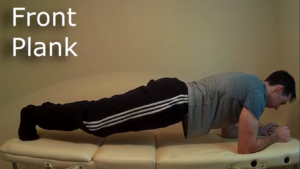


Finally I would suggest the planking movements; so front plank, side plank and reverse plank.
How long/often should I be doing these?
As I mentioned earlier, it’s all about continued progress; there are no specific times or set periods you need to be holding these exercises for. So let’s just say if you can hold the front plank for 30 seconds, then fantastic, but then maybe after a week or two you push it to 35 and then push it to 40 seconds. So that’s the key to progression. If you’re not struggling then you’re going to be cheating yourself into thinking that you’re going to be making any real sort of progress. I would typically suggest we are all doing some form of exercises (core or otherwise) at least once per day.
Just remember that working hard shouldn’t be painful. If you’re experiencing pain then just probably best to skip that one particular exercise and then move on to the next one, but if pain is becoming a recurrent problem then you definitely need to talk to a specialist.
So I hope this article has been useful. If you have any questions just leave a comment and I’ll get back to you as quickly as I can!

Leave A Comment